Why It Works: The New Paradigm for Mental Growth
The Problem is Structural: Trapped in an Impossible Triangle
The global mental health crisis is rapidly worsening —
but existing digital wellbeing and growth solutions have reached structural limits.
Global Mental Health Crisis
More than 1 billion people worldwide struggle with mental health disorders.
Depression and anxiety have steadily increased over the past 30 years.
Counseling and medical systems cannot meet demand, leading to accessibility failure.
People want help — but cannot find solutions that work.
📊 Verified Data (WHO 2025, The Lancet 2024)
• 1.1 B people: Experience mental health disorders (1 out of every 7 individuals)
• +52% increase in youth anxiety (1990–2021)
• +13.4% increase in depression (1990–2021)
• $1T annual economic loss from depression/anxiety
• <10% treatment access in low-income countries
• 13 mental-health workers per 100,000 people
But the market and humanity are trapped in an impossible triangle.
The Impossible Triangle
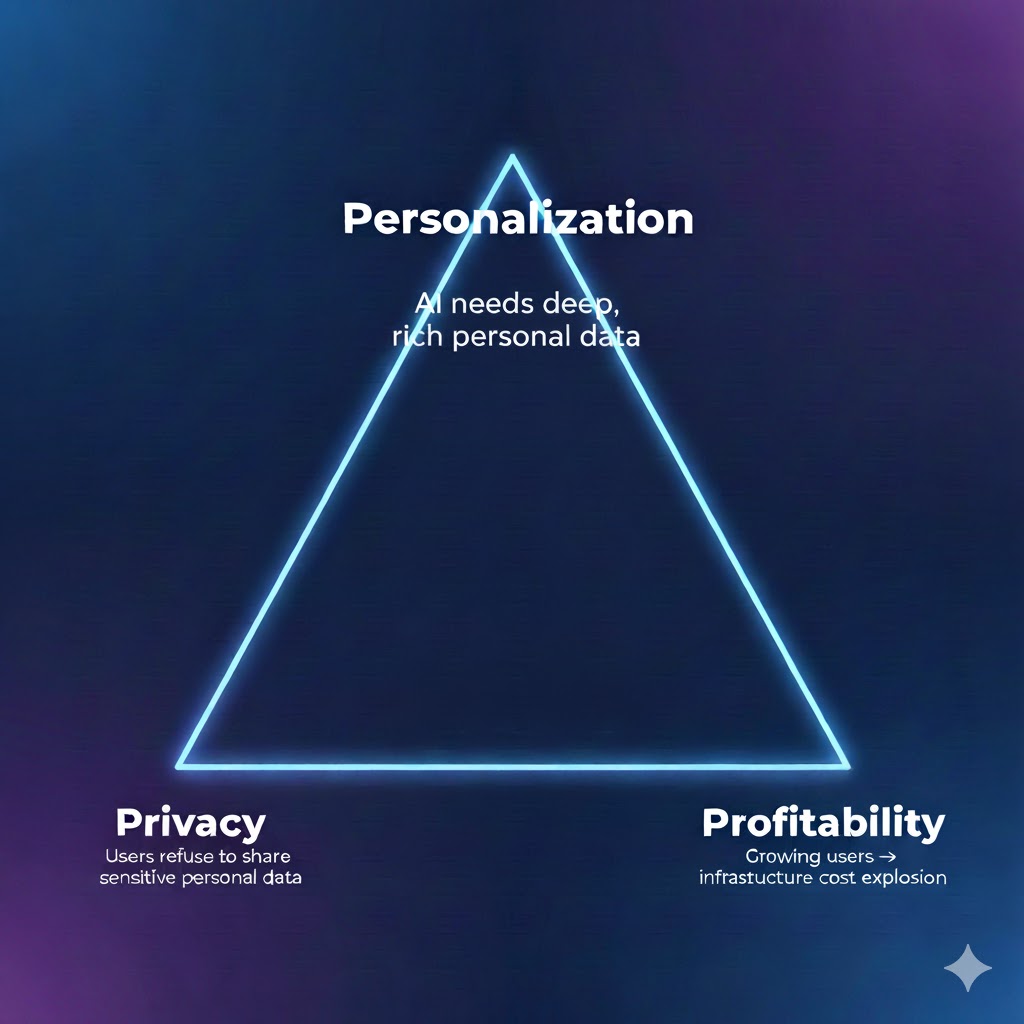
The market and people repeat failure the same way.
Hundreds of wellbeing apps launched over the last decade —
but they failed for the same reasons, and humans repeat the same patterns of frustration.
1️⃣ Repeated Problem #1 — Market Failure
The wellbeing / AI market continues to fail due to three structural problems:
① Privacy vs Personalization Paradox
To personalize AI, data must be sent to the cloud.
But users do not want that.
📊 Verified Data (Pew Research 2023, Accenture)
• 70% of Americans familiar with AI say they have little/no trust in companies using AI responsibly
• 41% cite privacy/data security as the #1 barrier
• 64% list privacy/data security as a top concern📊 KPMG 2024, Pew Research Additional Data
• 63% worry about risks of generative AI
• 84% fear exposure of data entered into AI
🔥 Impact: Limited personalization + privacy fear → collapse of user trust
② Unsustainable AI Cost Structure
Cloud-based AI = More users → More financial loss
- $5–15 monthly API cost per user
- Gross margin: 5–55%
📊 Verified Data (Character.AI, 2024)
• AI-chatbot cost at 100M DAU per year:
— Own infrastructure: $365M
— Commercial API dependency: $4.8B
• Character.AI monthly infra cost: millions
• Replika: 2.5M MAU peak → 2.0M
🔥 Impact: The more you scale, the more money you lose → Traditional AI cannot scale
③ Time Barrier + High Churn
People cannot sustain time-intensive wellbeing routines.
📊 Verified Data (Frontiers AI 2019, 2024)
• Average 30-day retention of mental-health apps: 3.3%
• Headspace: 7.65%
• Calm: 8.34%
• Insight Timer: 16% (industry best)
• AI chatbot apps monthly churn: 15%+
• 14% of apps use no persuasive strategy
• Manual tracking: boring and unsuitable for high-severity
🔥 Impact: People start but cannot continue → most quit within 3 weeks
2️⃣ Repeated Problem #2 — Human Failure
Humans fail not because of lack of willpower, but lack of structure.
① Reflection is not sustainable
The more complex the problem, the harder it is to sustain reflection.
🔥 Impact: No change occurs → lack of structured reflection is the problem
② Lack of Objectivity
Humans cannot see their own problems as data.
🔥 Impact: Lack of insight → repeated poor decisions
③ Cognitive Friction
Complex apps → Long routines → Avoidance.
📊 Behavioral Science Research (BJ Fogg, 2020)
• Behaviors under 2 minutes dramatically improve habit formation success
• Tiny Habits 5-day program: 80–90% report higher confidence in habit formation
• Key: Minimal effort determines sustainability
🔥 Impact: Habit failure → humans need much simpler routines
3️⃣ Why Existing Technology Cannot Solve This
Cloud AI structurally cannot solve this problem:
- Personalization requires cloud data → worsens privacy crisis
- Server cost cannot keep up with user growth
- Long AI conversations oppose human cognitive structure
🔥 Result: Existing AI wellbeing apps are structurally impossible to succeed
📊 Additional Structural Challenges — Frontiers AI (2019)
- 14% of apps use no persuasion strategy
- Manual input dependency unsustainable
- Lack of reward mechanisms
- Low credibility & poor privacy transparency
- More strategies ≠ better outcomes
(r = 0.153, p = 0.123 — strategy count irrelevant)
💥 Core insight: Wrong combination of strategies neutralizes effectiveness

4️⃣ Therefore, A New Paradigm Is Required
🔬 Scientifically Proven
✓ Correct reflection → improves brain health
• UCL (Neurology 2022) — 259 elderly study
• Higher reflective thinking → cognitive gains
• Better glucose metabolism, lower dementia risk✓ Insight → protects mental health
• Current Psychology (2023)
• Insight ↑ → depression/anxiety ↓, self-esteem ↑✓ Reflection vs Rumination
• Treynor et al. (2003)
• Brooding: passive → depression ↑
• Reflection: active → adaptive benefit✓ Structured process required
• BMC Psychiatry (2025, Japan 276 participants)
• Excessive / unstructured reflection → harmful
• Requires structured prompts + time boundaries✓ Experience → Insight → Wisdom
• Archives of General Psychiatry (2009)
• Wisdom ≠ mere accumulation of experience
• Wisdom = experience → reflection → insight✓ 2-minute routines enable habit success
• BJ Fogg, Tiny Habits (2020)
“AI can think for us — but it cannot reflect for us.”
Key insight we discovered
Human limitation is not lack of thinking —
it is inability to sustain correct reflection.
Most people fall into rumination, not reflection — causing harm.
AI should not be a provider of answers, but an enabler of structured reflection.
To achieve this, we need:
Structured reflection + Complete privacy + Ultra-low cost + 2-minute routine + Specialized AI
🎯 Final Message: The Power of Structured Reflection
“AI can think for us — but it cannot reflect for us.”
Our key insight is that human limitation is not a lack of thinking, but an inability to sustain correct reflection. We combine the ultimate security of on-device technology with a scientifically proven structure to enable true, lasting growth.
✅ Scientifically Proven Results:
- UCL (Neurology 2022): Higher reflective thinking leads to cognitive gains and lower dementia risk.
- Current Psychology (2023): Increased insight reduces depression/anxiety and boosts self-esteem.
🚀 Experience The New Paradigm Today
The market has failed. Humans are failing. Existing technology cannot solve this problem.
The Last 2 Minutes is the required paradigm shift.
[CTA BUTTON] Be the First. Join the Waitlist.
References / Sources
| Source | Description / Use in Slide |
|---|---|
| World Health Organization (2025) report | Global mental-health prevalence data |
| The Lancet (2024) | Trends in depression and anxiety over 30 years |
| Pew Research Center (2023) | Public trust in AI & privacy concerns in the U.S. |
| Accenture (2023) | Survey data: privacy/data security as barrier to AI adoption |
| KPMG (2024) | Additional generative-AI risk and data-privacy survey data |
| Character.AI internal data (2024) | Operating costs for large-scale AI-chatbot deployments |
| Frontiers in AI (2019, 2024) | Retention/churn data for mental-health and AI apps |
| BJ Fogg — Tiny Habits (2020) | Behavioral-science findings on low-effort habit formation |
| UCL – Neurology (2022) | Study: reflective thinking improves cognitive function in elderly |
| Current Psychology (2023) | Study: increased insight reduces depression/anxiety, boosts self-esteem |
| Treynor et al. (2003) | Research distinguishing brooding vs. active reflection |
| BMC Psychiatry (2025, Japan) | Study: unstructured or excessive reflection can worsen mental health |
| Archives of General Psychiatry (2009) | Findings on how experiential reflection → insight → wisdom |
Note: The citations reflect the sources as listed in the original document. For academic or public-facing materials, please verify titles, authors, volume/pages as required.
 The Last 2 Minutes